

Summary:
UAE Police Clearance Certificate Rule (2026) – Key Takeaways
• Mandatory for nationals of 45 countries.
• Applies primarily to new residence visa applications.
• Introduced in three phases beginning 16 June 2026.
• Certificate must be issued in home country.
• Must be attested before translation.
• Usually not required for standard visa renewals.
• Processing time varies from several days to several weeks.
If you’re relocating to Dubai, setting up a company in the UAE, sponsoring staff, or renewing a residence visa, there’s a new rule you need on your radar. Starting 16 June 2026, the UAE’s Federal Authority for Identity, Citizenship, Customs & Port Security (ICP) is rolling out a mandatory UAE Police Clearance Certificate (PCC) – also called a Good Conduct Certificate – for new visa applicants from 45 nationalities, phased in over the second half of 2026.
At Soho Zone, our team lives in the UAE, dealing daily with company formation, PRO services, and relocation cases every single day. We’re not reporting on this from the outside – we’re already adjusting client visa files, employer applications, and Golden Visa timelines around it.
Here’s the plain-English breakdown of what’s changing, who it affects, and how to stay ahead of it.
What Is the UAE Police Clearance Certificate Rule?
A Police Clearance Certificate is an official document from a home-country police or government authority confirming that a person has no criminal record. Under the new ICP requirement, nationals from 45 listed countries must obtain a Police Clearance Certificate in their home country and have the relevant UAE Embassy or Consulate attest it before authorities can approve a new UAE visa or entry permit.
This is part of a broader tightening of UAE immigration and visa compliance standards, alongside recent moves like the unified national health insurance system and updates to the Golden Visa framework. The direction is clear: the UAE is professionalizing its entry and residency processes, and due diligence at the border is becoming standard, not exceptional.
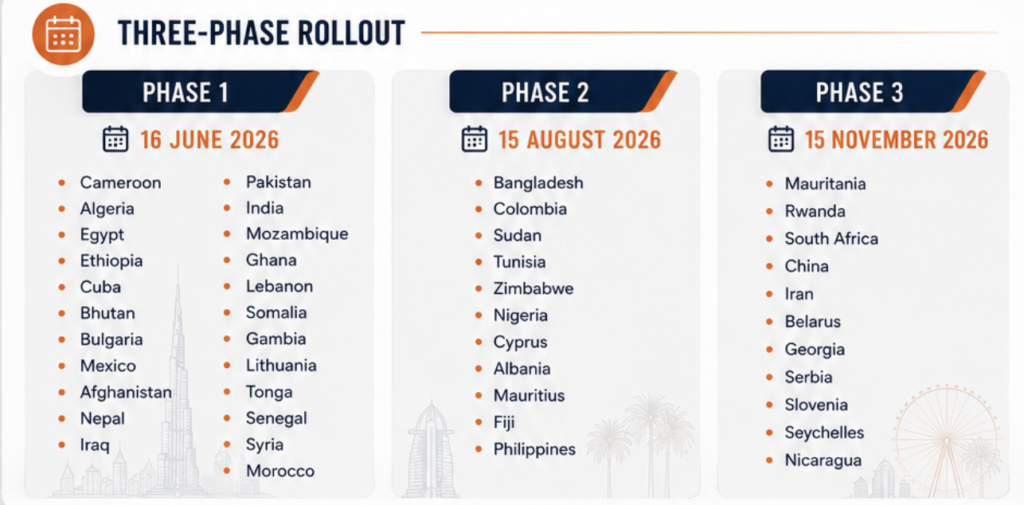
The Three-Phase Rollout
The requirement is being introduced in three stages, giving employers, sponsors, and business setup consultants time to prepare documentation in advance.
| Phase | Effective Date | Nationalities (partial list) |
| Phase 1 | 16 June 2026 | Cameroon, Algeria, Egypt, Ethiopia, Cuba, Bhutan, Bulgaria, Mexico, Afghanistan, Nepal, Iraq, Pakistan, India, Mozambique, Ghana, Lebanon, Somalia, Gambia, Lithuania, Tonga, Senegal, Syria, Morocco |
| Phase 2 | 15 August 2026 | Bangladesh, Colombia, Sudan, Tunisia, Zimbabwe, Nigeria, Cyprus, Albania, Mauritius, Fiji, Philippines |
| Phase 3 | 15 November 2026 | Mauritania, Rwanda, South Africa, China, Iran, Belarus, Georgia, Serbia, Slovenia, Seychelles, Nicaragua |
Important: country lists and effective dates are still being finalized by ICP and can shift slightly between official circulars. If your nationality is close to the line, this is exactly the kind of detail we track for clients as part of ongoing PRO government services support – always confirm your exact phase before booking flights or submitting paperwork.
Does this apply to Visa renewals or only first-time applications?
This is the question we’re hearing most from clients already living and working in Dubai – and it matters, because nobody wants to fly home just to renew a residence visa.
Based on current ICP guidance, the PCC requirement applies to new UAE visa and entry permit applications. If you’re already a UAE resident renewing your visa or switching jobs within the country, you’re generally not required to obtain a fresh police clearance certificate from your home country. In many cases, a UAE-issued Good Conduct Certificate – the kind residents can already access quickly through the Ministry of Interior, Dubai Police app, or UAE Pass – is sufficient to satisfy internal checks.
That said, requirements can vary by free zone authority, emirate, and employer, so this isn’t a blanket guarantee. This is precisely the kind of nuance where working with an experienced UAE relocation and business setup partner protects you from unnecessary delays, rejected applications, or wasted trips home.
What first-time applicants need to prepare
If you’re applying for your first UAE visa – whether for employment, investment, a Golden Visa, or company sponsorship – and your nationality is on the list, here’s what your PCC needs to look like:
- Issued by the competent authority in your country of nationality (police, home affairs, or equivalent government body)
- Attested by the relevant UAE Embassy or Consulate before submission – attestation must happen at the correct embassy, which is not always the embassy in your home country. For example, applicants from Bhutan currently attest through the UAE Embassy in India, and applicants from Gambia through the UAE Embassy in Senegal
- Translated only after attestation, not before – translating first can invalidate the attestation seal and trigger an automatic rejection by ICP
- Additional legalization or notarization, depending on your home country’s documentation standards
Timelines vary widely by country – from a few days to several weeks – so this is not a step to leave until the last minute, especially if you’re coordinating a company formation, an employment visa for new hires, or a family relocation on a deadline.
Why This Matters for Founders, Investors, and Employers in the UAE
Whether you’re forming a mainland or free zone company, sponsoring your first employees, applying for a Golden Visa, or relocating your family to Dubai, visa compliance is now a genuine project-planning variable – not paperwork you handle in the final week.
This is exactly where a full-service UAE business setup and relocation partner earns its place. At Soho Zone, our team is directly and personally involved in every case that comes through our doors – from company registration and trade licensing, to PRO government services, visa processing, Emirates ID, banking, compliance, and the everyday realities of settling a family into Dubai life. We monitor ICP updates as they happen, so our clients learn about new requirements before they cost them time.
Our philosophy is simple: guidance before problems, clarity before decisions, trust above all. We stay by your side long after your company is registered and your visa is issued, supporting you as your business and your life in the UAE evolve.
Quick FAQ
Is the Police Clearance Certificate required for UAE visa renewals? Generally, no – this requirement is aimed at new visa and entry permit applications. Residents renewing an existing visa typically rely on a UAE-issued Good Conduct Certificate instead.
Who issued this new UAE visa rule? The UAE Federal Authority for Identity, Citizenship, Customs & Port Security (ICP).
Does the PCC need to be translated? Only after it has been attested by the UAE Embassy or Consulate – never before.
Which nationalities are affected first? Phase 1 begins on 16 June 2026 and includes nationalities such as India, Pakistan, Egypt, Mexico, Afghanistan, and Morocco, with Phases 2 and 3 following in August and November 2026.
Who needs a police clearance certificate?
The Police Clearance Certificate (PCC), also known as a Good Conduct Certificate, is required for new UAE residence visa and entry permit applicants from nationalities included in the UAE’s phased rollout announced by the Federal Authority for Identity, Citizenship, Customs & Port Security (ICP).
The requirement primarily affects individuals applying for:
- Employment visas
- Investor and partner visas
- Golden Visas
- Company owner visas
- Family-sponsored residence visas (where applicable)
If your nationality is included in the rollout, obtaining the PCC should become one of the first steps in your relocation planning rather than something left until the final stages of your visa application.
Because requirements may vary depending on the visa category, sponsoring authority, and emirate, applicants should always verify the exact documentation required before submitting an application.
Does this apply to visa renewals?
Based on current ICP guidance, the requirement primarily applies to new UAE residence visa and entry permit applications rather than standard visa renewals.
If you already hold a valid UAE residence visa and are:
- renewing your residence visa,
- changing employers while remaining in the UAE,
- transferring sponsorship,
- or renewing a company owner’s visa
You will generally not need to obtain a new Police Clearance Certificate from your home country.
In many cases, you can instead meet the requirement by providing a UAE-issued Good Conduct Certificate.
However, individual requirements may differ depending on the free zone authority, mainland authority, employer, or the specific circumstances of your application. Checking the latest requirements before beginning the process remains the safest approach.
Which nationalities are included?
The new requirement is being introduced in three implementation phases throughout 2026, eventually covering 45 nationalities.
The first phase began on 16 June 2026, followed by additional groups on 15 August 2026 and 15 November 2026.
Countries included in the rollout include, among others:
Because the ICP may update implementation dates and country lists through official circulars, always confirm that your nationality is included before you begin the visa process.
How Do You Obtain a police clearance certificate?
The process depends on your country of nationality, but in most cases it follows these steps:
- Apply through your country’s police authority, ministry of interior, or equivalent government institution.
- Receive the official Police Clearance Certificate.
- Complete any required legalization procedures in your home country.
- Obtain attestation from the appropriate UAE Embassy or Consulate.
- Translate the document if required.
- Submit the finalized document with your UAE visa application.
Processing times vary significantly between countries, so start the process as early as possible, especially if your relocation or employment has a fixed start date.
Where must the PCC be attested?
The UAE Embassy or Consulate responsible for the country where the Police Clearance Certificate was issued must attest the document.
This is one of the most common areas of confusion.
The appropriate embassy is not always located in your own country.
For example:
- Applicants from Bhutan currently complete attestation through the UAE Embassy in India.
- Applicants from Gambia generally use the UAE Embassy in Senegal.
Using the incorrect embassy can delay or invalidate the application, making it important to verify the correct diplomatic mission before submitting documents for attestation.
Can I translate it before attestation?
No.
In most cases, you should translate the Police Clearance Certificate only after the relevant UAE Embassy or Consulate has properly attested it.
Translating the document before embassy attestation can invalidate official seals or prevent authorities from recognizing the original certification, which may lead them to reject the document.
Following the correct sequence—issue, legalization (where required), embassy attestation, and then translation—helps avoid unnecessary delays.
How long does it take?
There is no single processing time because every country has different procedures.
Depending on your country of nationality, obtaining a Police Clearance Certificate may take anywhere from a few working days to several weeks.
Additional time may also be required for:
- notarization,
- legalization,
- embassy attestation,
- certified translation,
- courier delivery,
- and government processing.
Applicants planning company formation, employment onboarding, or family relocation should allow sufficient time before their intended travel date to avoid unnecessary delays.
What happens if my PCC is rejected?
If the police clearance certificate does not meet ICP requirements, your visa application may be delayed until a compliant document is provided.
Common reasons for rejection include:
- incorrect issuing authority,
- missing embassy attestation,
- translation completed before attestation,
- expired certificate,
- incomplete legalization,
- damaged or unreadable documents,
- or submission of an incorrect document type.
Correcting documentation after submission often takes much longer than preparing it correctly from the beginning, so always verify your documents before you file them.
Common Mistakes That Can Delay Your UAE Visa Application
The introduction of the Police Clearance Certificate (PCC) requirement adds another important compliance step to the UAE visa process. Based on how immigration procedures typically work, these are some of the most common issues applicants should watch out for.
1. Waiting until the visa application is ready
Many applicants begin gathering documents only after their employer or business setup is complete.
A Police Clearance Certificate can take anywhere from several days to several weeks to obtain, and additional legalization, embassy attestation, and translation can extend the timeline further.
Best practice: Start obtaining your PCC as soon as you know you’ll be applying for a UAE residence visa.
2. Translating the certificate before embassy attestation
One of the easiest – and most expensive – mistakes people make is translating the Police Clearance Certificate (PCC) before the relevant UAE Embassy or Consulate attests it.
Many authorities require the embassy to authenticate the original document before you translate it. If you translate the PCC too early, you may invalidate the process and have to obtain a new document or repeat the attestation.
Correct order:
- Obtain PCC
- Complete legalization (if required)
- UAE Embassy attestation
- Certified translation
- Submit with the visa application
3. Using the Wrong UAE Embassy
Many applicants assume they should have their documents attested by the UAE Embassy in their own country.
This isn’t always the case.
Some countries are served by UAE embassies located in neighboring countries. Sending documents to the wrong embassy can add weeks to the process.
Always confirm which UAE diplomatic mission has jurisdiction over documents issued in your country.
4. Assuming Visa Renewals Follow the Same Rules
Many residents immediately assume they’ll need to travel home to obtain a new Police Clearance Certificate every time they renew their visa.
Based on current guidance, the requirement primarily applies to new residence visa and entry permit applications, not routine renewals.
Checking your specific visa category before making travel arrangements can save significant time and expense.
5. Using an Expired Police Clearance Certificate
Some countries issue PCCs with relatively short validity periods.
If too much time passes between issuance and visa submission, authorities may request a newer certificate.
When planning a relocation, try to obtain the PCC close enough to your intended application date that it remains valid throughout the process.
6. Assuming Every Country Has the Same Procedure
There is no universal PCC process.
Some countries issue certificates online.
Others require fingerprints.
Some require in-person attendance.
Others require local representatives or a power of attorney.
Processing times and documentation requirements vary considerably by country.
7. Forgetting Additional Legalization Requirements
For some jurisdictions, obtaining the Police Clearance Certificate is only the first step.
You may need to complete additional legalization or authentication before the UAE Embassy can attest the document.
If you skip this step, authorities may reject the document later in the process.
8. Booking Flights Before Documents Are Ready
This is surprisingly common.
Many applicants book flights, accommodation, or office start dates before confirming that they have completed all documentation and that the relevant authorities have accepted it.
If the PCC or attestation process takes longer than expected, you may need to postpone your relocation plans.
Whenever possible, wait until critical immigration documents are progressing as expected before making non-refundable travel commitments.
9. Assuming a Digital Copy Is Always Accepted
Some applicants believe that downloading a digital Police Clearance Certificate is sufficient.
Acceptance depends on:
- the issuing authority,
- the country,
- embassy requirements,
- and ICP documentation standards.
Always confirm whether an original, digitally signed, or legalized version is required for your specific application.
10. Relying on Outdated Online Advice
Immigration rules evolve regularly.
Information published on forums, social media, or older blog posts may no longer reflect current ICP procedures.
Always verify requirements using the latest official guidance or with an experienced advisor before submitting your application.
Can Soho Zone Help?
Yes.
Our team guides founders, investors, employees, and families through every step of relocating to the UAE, managing the practical aspects of visa applications and company formation. We identify document requirements, coordinate with government authorities, and prepare applications correctly before submission.
We support clients with:
- UAE company formation
- Employment and investor visas
- Golden Visa applications
- PRO and government liaison services
- Emirates ID processing
- Corporate banking support
- Family relocation
- Ongoing compliance
Rather than simply submitting paperwork, we help clients understand which requirements apply to their specific circumstances, reducing the risk of delays, rejected applications, or unnecessary travel.
Planning a company formation, employment visa, Golden Visa, or full relocation to Dubai? Soho Zone’s team handles UAE business setup, PRO government services, banking, compliance, and relocation end-to-end – with founders and senior team members directly involved in every client’s process, not passed off to a call center. Book a free 1-hour consultation via WhatsApp at +971 50 996 5829 or through soho-zone.com and get clarity before you make your next move.
This article reflects ICP guidance as of July 2026. RUAE authorities may update requirements, country lists, and implementation dates at any time. Always confirm the latest rules with an authorized PRO or consultant, or directly through the ICP, before submitting your application.